The Basics of Tax Brackets for Legal Professionals

posted in: Tax Tips 0

legal professsion tax brackets

More legal professionals search Google for information on tax brackets than any other tax topic.

Whether you’re interested in your own tax situation or that of a client, it’s important to understand the basics of the subject. With a tax code numbering in the tens of thousands of pages (73,954), you might think it’s an impossible task to decipher tax brackets. Actually, it’s not that difficult.

Of course, different people fit into different statuses related to their tax payments. They different categories are: “single,” “married and filing jointly,” “married and filing separately” or “head of household.” Each of these categories has a different scale but let’s just look at the simplest category first.

For a single person, tax brackets are as follows (2014 figures):

Income up to $9,075               10%

$9,076 – $36,900                    15%

$36,901 – $89,350                  25%

$89,351 – $186,350                28%

$186,351 – $405,100              33%

$405,101 – $406,750              35%

$406,751 and up                     39.6%

 Because the two most common statuses for filing are single and married filing jointly, I’ll give you the brackets for married filing jointly as well:

Income up to $18,150             10%

$18,151 – $73,800                  15%

$73,801 – $148,850                25%

$148,851 – $226,850              28%

$226,851 – $405,100              33%

$405,101 – $457,600              35%

$457,601 and up                     39.6%

Where Most People Get it Wrong

Many people have the mistaken idea that if they earn $100,000, their entire income is taxed at 28% so their tax would be $28,000. That’s not correct. The percentage doesn’t apply equally to every dollar you make. It’s easiest to explain how it does work by showing you the numbers.

A single person with taxable income of $100,000, the first $9,075 is taxed at 10% = $907.50

The income between $9,076 and $36,900 is taxed at 15%  = $4,173.75

The income between $36,901 and $89,350 is taxed at 25% = $13,112.50

And that last $10,650 of the $100,000 earned is taxed at 28% = $2,982.00

Total tax owed is $21,175.75—not $28,000.

As most people have their taxes withheld from their wages, they may not give much thought to setting aside future tax payments for any additional income they might make. However, that additional income will be taxed at the highest possible rate, so one should start setting aside tax payments as soon as this additional income starts (to make sure you’re not hit with a big—and unwelcome—tax bill in April). For example, let’s say our $100,000 professional starts a side business to provide legal seminars. In addition to his job that pays him $100,000 annually, he picks up an additional $15,000 from his side business. This extra income will be taxed at 28%, meaning that he should be setting aside at least $4,200 for his future tax bill.  In addition, his side business income is also subject to self-employment tax of up to 15.3%.

Why This Progressive System?

The thinking behind the tax codes is that high earners can afford to pay more to the government and still have sufficient money to support themselves and their families. And high earners normally have more charitable donations and other deductions to reduce their tax burdens, anyway.

However, keep in mind that these numbers are constantly changing. When you or your clients get around to filing 2015 returns, the numbers will change due to cost of living adjustments. For example, the 10% bracket will extend up to $9,225 for a single person and the 35% bracket will top out at $411,500 instead of $405,100. This is true for every bracket.

A Brief Look at the History

The Sixteenth Amendment to the U.S. Constitution, ratified in 1913, allowed the federal government to levy a federal income tax. That year, the tax brackets were much simpler. A single person paid 1% on earnings of more than $3,000 per year, and a couple paid 1% on income of more than $4,000. Anyone earning more than the incredible sum of $20,000 per year was subject to a graduated surtax.

Due to inflation and additional complexities of the law, today graduated taxes are a part of life for every professional. However, these same tax code complexities also provide ways to significantly reduce your tax burden. As a professional, you can save yourself tens of thousands of dollars each year—but you have to know what they are.

Before you do your taxes, make sure they’re looked over by a competent tax strategist to ensure you’re getting every possible deduction and keeping more of your hard-earned money.

Disclaimer

This article in no way attempts to explain all the intricacies of tax brackets.  Tax laws and regulations are subject to continual change, and this especially applies to this area.  For example, there are new laws that can apply a sort of “surtax” to individuals at specific income levels under special circumstances.  Because of this, I would highly recommend that readers contact their tax professional or our office to inquire about specific situations. 

 

6 Things to Know About Reducing Taxes by Hiring Your Kids

posted in: Tax Tips 0

paying family membersYou work hard for your income—so why not keep it in the family? There’s a way to do this that might be a lot simpler than you think. If you are supporting children, parents or other dependents, you can legitimately reduce your taxes by intelligently putting these individuals on your payroll.

How is this done?

When you pay a dependent, that money comes off the top of your income and shifts to someone else who will be taxed at a lower rate. This is an easy and effective method of reducing the overall taxes the household pays.

When using this strategy, there are just a few things to keep in mind:

  1. Anyone you hire must be at least seven years old.
  2. Their first $6,300 of earned income is taxed at zero. That’s because $6,300 is the standard deduction for a single taxpayer, even when you claim them as your dependent. And up to $9,225 of taxable income is taxed at just 10%. (2015 IRS Codes used here.)
  3. You have to pay them a “reasonable” wage for the service they perform. The tax court says a “reasonable wage” is what you’d pay a commercial vendor for the same service, with an adjustment made for the child’s age and experience.
  4. To audit-proof your return, write out a formal job description and keep a timesheet for all work provided.
  5. Pay by check, so you can document payments.
  6. The money must be deposited into an account in the child’s name. But it doesn’t have to be an account he has access to. It can be a Roth IRA for decades of tax-free growth. It can be a qualified college tuition plan, usually referred to as a Section 529 plan. Or it can be a custodial account that you control until they turn 21.

Let’s take a look at how these points might work out in real life.

Lower Tax Bracket

Consider a situation where an attorney makes $450,000 a year and hires his son to do simple maintenance tasks around the office—painting, keeping the grounds groomed and so on. Over a year’s time the son earns $10,000, which reduces the father’s income by the same amount. For the father, that $10,000 would have been taxed at 39.6% or $3,960. But for the son, the first $6,300 isn’t taxed and the remaining $3,700 is taxed at 10% = $370. That’s a tax saving of $3,590.  What would you do with an extra $3,590?  You can add this amount into his college savings account, take a short vacation, or make a few car payments.

Reasonable Wage

If your 12-year-old son cuts grass for investment properties, pay him what a landscaping service might charge because there is little difference between the job a landscaper would do and the one your son delivers. If you have your child help you with data entry or filing, pay them just a bit less than a bookkeeping or clerical service might charge.

The same would apply to hiring your teenager to help with a website, posting blogs or doing social media. What would a marketing service charge for these services? It could be sizeable. In many cases, paying a reasonable wage can add up to quite a lot of money.

Custodial Account

One thing to remember is that you don’t have to put these funds in an account your child has access to. They can go into a custodial account you keep for them. A custodial account can’t be used to cover your basic obligations of support as a parent, but it can cover many other things. Private and parochial schools, summer camps and similar items aren’t considered obligations of parental support.

Therefore, if your teenage daughter wants to spend two weeks at horse camp, you could either:

  1. Earn the fee yourself, pay taxes on it and pay for camp with your after-tax dollars, or
  2. Pay her to work in your business, deposit the check in her custodial account and then, as custodian, write the check to the camp. The ultimate effect of this transaction is to let you deduct her camp as a business expense.

If you hire your child to work in an unincorporated business, you don’t have to withhold funds for Social Security until they turn 18. So this really is tax-free money. You’ll still have to jump through some paperwork hoops, like issuing a W-2 at the end of the year and helping them file their own return if the income is enough to require them to file. But this is a small price to pay compared to the tax you’ll waste if you don’t take advantage of this strategy.

Hiring dependents provides a tax savings that may be overlooked by attorneys and other professionals, but I encourage you to consider it. When organized properly, hiring dependents is a very defensible and effective method of reducing your tax bill.

This is just one of many tax-saving strategies professionals can take advantage of. Visit a tax expert to see what else is available to you. According to the IRS, Americans overpay their taxes by $1 billion annually. A good tax strategist doesn’t just do your returns at tax time. They use their extensive knowledge of tax codes all year long to help their clients correctly structure their income and outgo.

At the end of the day, our goal is simple: to help you keep more of your hard-earned money.

Are Home Office Expenses A Risky Deduction?

posted in: Tax Tips 0

home office expensesHome office expenses may be the most misunderstood deduction in the entire tax code. That’s unfortunate because millions of Americans actually qualify for this deduction. According to Forbes three million Americans never set foot in their company’s office and as many as 30 million work at home at least one day a week. This is particularly relevant for professionals such as attorneys.
For years, it was rumored that deducting expenses for a home office guaranteed an audit. Some tax professionals were apparently not well versed in this part of the tax code and may not have given their clients all the deductions they were eligible for.

Also, there have been a couple of changes that made it easier to qualify for this deduction – one, courtesy of the Supreme Court back in 1994, and another from Congress in 2007. So now you can feel more confident about claiming home office deductions without risking an audit.

There are three rules that determine whether or not your home office is deductible:

  1. Is it your principal place of business?
  2. Do you use it to meet clients or prospects in the normal course of your business?
  3. Is it a separate structure not attached to your dwelling unit?

Now, realize that your home office doesn’t have to meet all three requirements—any one of them can qualify it as a deduction. We’ll clarify this further for you so you can make an adjudication in your situation.

Principal Place of Business

This is where most home offices will qualify as deductible. (The IRS Publication that applies here is Publication #587).  Here’s how the IRS describes a home office that’s a principal place of business:

  1. It’s used “exclusively and regularly for administrative or management activities of your trade or business,” and
  2. There’s “no other fixed location where you conduct substantial administrative or management activities of your trade or business.”

If you have another office somewhere else but you only use it occasionally for administrative or management activities, then your home office will still qualify.

Example: You are an attorney and you have a virtual office or shared office space where you meet your clients. Your home office still qualifies as your principal place of business so long as you use it to manage your business and keep your books and you don’t regularly do that at your virtual office or shared office space.

Working Out of a Corner of Your Living Room?

Your home office doesn’t have to be an entire room. You can use part of a room as long as it meets the requirements we’ve already covered.

If you do have a “separately identifiable” space such as a workshop, studio, storage building or other space you use to create or store records, products or samples, then you can also claim that space as a deduction. But if you use these spaces for more than one business, both have to qualify to take the deduction.

A qualifying space must be used regularly and exclusively for business. “Regularly” generally means 10-12 hours per week. To provide evidence for your deduction, take photos of your workspace and keep of log of time spent working there.

Once you’ve determined that your space qualifies, you’ll need to calculate the proportion of your home expenses that can be applied to your home office.

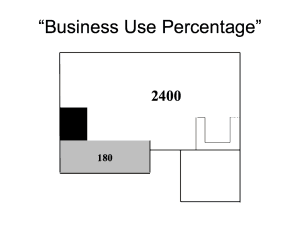
  • business use percentageStart by calculating the percentage of your home used for your business. As you can see in this diagram, this person’s home is 2,400 square feet. The home office takes up 180 square feet or 7.5% of the total square footage. (Exclude common areas like halls and stairs to boost the percentage used for business.) Or you can divide your expenses by the number of rooms, if they’re roughly equal in size.
  • Next, deduct that percentage from your rent or your mortgage interest and property taxes. (As an aside, deducting those expenses on your business return can save you more than on your personal return. For example, if you’re subject to AMT (Alternative Minimum Tax), you lose your property tax deduction. If your AGI – Adjusted Gross Income – is over $305,050, the Pease limitation (named after the late Congressman Donald Pease) cuts your itemized deductions. Claiming a home office lets you rescue that lost deduction, at least for the part of the home you use for business.)
  • You can also depreciate the business use percentage of your home’s basis excluding land over 39 years as nonresidential property. (According to the IRS, “Basis is the amount of your investment in property for tax purposes.” This usually refers to the cost but there are other factors involved as well.)
  • Finally, deduct your business use percentage of utilities, repairs, insurance, garbage pickup and security.

You should also plan to deduct direct expenses from your business, such as high electric bills for home office expenses or fast internet service installed especially for your business.

Claiming a home office also increases your car and truck deductions, because it eliminates nondeductible commuting miles for that business.

These deductions will help reduce taxable income and self-employment income from your business. If your home office expenses in a particular year are more than your net income from your business, you can carry forward the difference to future years.

If the time comes to sell your home you’ll have to recapture any depreciation you claimed, or could have claimed, after May 6, 1997.  And you can still claim the usual $250,000 or $500,000 tax-free exclusion for space you use for your office unless it is a “separate dwelling unit”.

If this all seems like too much work, there’s a new “safe harbor” method that lets you claim a flat $5 per square foot (regardless of your actual expenses) for up to 300 square feet of qualifying home office space (regardless of what percentage it occupies in your home). If you use the safe harbor, you’ll continue to deduct your mortgage interest and property tax on Schedule A. However, you’ll forego any depreciation deduction. And if the safe harbor deduction reduces your business income below zero, there’s no carrying forward the loss.

The safe harbor is certainly easier than the traditional method. However, using it might not let you claim nearly as much as the traditional method. The only way to know is to run the numbers and calculate the deduction both ways.

Of course, this isn’t all there is to the subject of home office deductions, but it should give you a pretty good idea of how it works. There are intricacies we haven’t discussed which could increase your savings even more. Contact a tax professional for the specific details of your situation.

There are many tax-saving strategies available to attorneys if they know what they are. Home office deductions are just one of them. At the end of the day, the goal is simple: to help you keep more of your hard-earned money.

Background Check Laws

posted in: Tax Tips 0

Tax Tips are not a substitute for legal, accounting, tax, investment or other professional advice. Always consult with your trusted accounting advisor before acting upon any Tax Tip.

As a small business owner, you may be concerned about whether you are required to conduct background checks on prospective or current employees, or whether you are allowed to do so even if you are not required to do so. Understanding when a background check is required, when one is allowed, and what information can be used as the result of a background check is crucial for a small business owner in order to avoid fines, penalties and even litigation.

A background check may be required by federal or state law. Government employers often conduct background checks as a matter of course. Individual state laws also frequently require backgrounds checks when an employee will be working around certain “vulnerable” individuals such as children, elderly or the disabled. Failure to comply with state or federal laws that require a background check could subject you, as the employer, to fines and penalties or may open you up to a lawsuit on the basis of negligent hiring in the event someone is ultimately injured by your employee. Be sure to check your individual state laws with regard to background checks.

Many businesses are choosing to conduct background checks as a precautionary measure, even when not required to do so. While no measure is fool-proof for preventing fraud, tortious conduct or other libelous actions by an employee, a background check can offer some reassurance as well as provide a defense in the event something does go wrong and you are sued for damages.

What can, and cannot, be reported on a background check is extremely important to understand as a small business owner. Because a background check is considered a “consumer report”, the Fair Credit Reporting Act (FCRA) sets the federal standards for what can be included; however, state laws may set further limitations. In general, anything that is considered “public record” may be included in a background check including things such as criminal convictions, bankruptcy filings and workers’ compensation claims.

To further complicate matters, however, some things may be included on a background check but cannot be used against the employee when making a hiring decision. A bankruptcy, for example, may be included on a background check; however, you may not, as a general rule, discriminate against a prospective employee on the basis of the bankruptcy. Likewise, although workers’ compensation claims may be included in a background check, the fact that an employee filed a claim can only be considered with regard to whether the reason for the claim may interfere with the prospective employee’s ability to perform the job.

TAX ADVICE DISCLAIMER: In accordance with IRS Circular 230, any tax advice included in this communication, including attachments, is not intended or written to be used, and cannot be used by you or any other person or entity, for the purpose of avoiding penalties that may be imposed under the Internal Revenue Code or applicable state or local tax law provisions, nor may any such advice be used to promote, market or recommend to another party any transaction or matter addressed within this communication. If you would like such advice, please contact us.

Retirement Savings Options for Small Businesses in 2013

posted in: Tax Tips 0

Tax Tips are not a substitute for legal, accounting, tax, investment or other professional advice. Always consult with your trusted accounting advisor before acting upon any Tax Tip.

Today’s small business owners face many challenges when it comes to making their businesses grow and succeed. Retirement planning often takes a back burner to what business owners feel are more pressing concerns. However, a retirement plan isn’t nearly as complicated, or as expensive, as you might have imagined. With these retirement savings options tailor-made for small businesses, you’re sure to find a plan that’s right for your business needs.

401 (k) Plans

Small businesses tend to favor 401 (k) plans above other options available to them. With this retirement savings option, employees may defer parts of their salaries into an employer-sponsored 401(k) program. The deferrals are commonly made with pre-tax income and employers may opt to match the contributions (or a percentage of the contributions) of their employees. The pre-tax contributions of employees and employers alike are not taxed until the funds – and their earnings – are distributed.

IRAs

This is the simplest plan to offer as it simply allows employees to purchase IRAs through payroll deductions. Employees make the decisions about the amount they contribute and it simply allows them to set aside the funds each month in small, tax-deductible, increments rather than paying one lump-sum at the end of the year. As another option, small business owners can invest, and encourage their employees to enroll in a Roth IRA, which provides a benefit of tax-free disbursement.

Simplified Employee Pensions

These are sometimes referred to as SEPs. These are IRAs that are created by employers contributing a percentage of each employee’s pay. The percentage must be uniform and cannot exceed 25 percent of the total pay of $51,000 for 2013. Employers can change contributions from year to year according to economic conditions within the business.

Because there are several different retirement savings plans available for small businesses today, it’s a good idea to shop around to find the best match for your business situation.

TAX ADVICE DISCLAIMER: In accordance with IRS Circular 230, any tax advice included in this communication, including attachments, is not intended or written to be used, and cannot be used by you or any other person or entity, for the purpose of avoiding penalties that may be imposed under the Internal Revenue Code or applicable state or local tax law provisions, nor may any such advice be used to promote, market or recommend to another party any transaction or matter addressed within this communication. If you would like such advice, please contact us.